How to Choose the Right Air Compressor for Bottle Blowing Machine
Selecting the right air compressor for a bottle blowing machine is a decision that directly determines production quality, operational cost, and regulatory compliance. The compressed air used in stretch blow molding contacts the bottle interior at pressures up to 40 bar, making purity and stability non-negotiable. This guide provides a systematic framework for choosing the right air compressor for your bottle blowing machine, covering pressure requirements, flow calculations, purity standards, and total cost of ownership analysis.
Whether you are commissioning a new bottling line or replacing aging equipment, the methodology presented here eliminates guesswork and delivers specifications matched to your actual production requirements.
Understanding Your Bottle Blowing Machine’s Air Demand
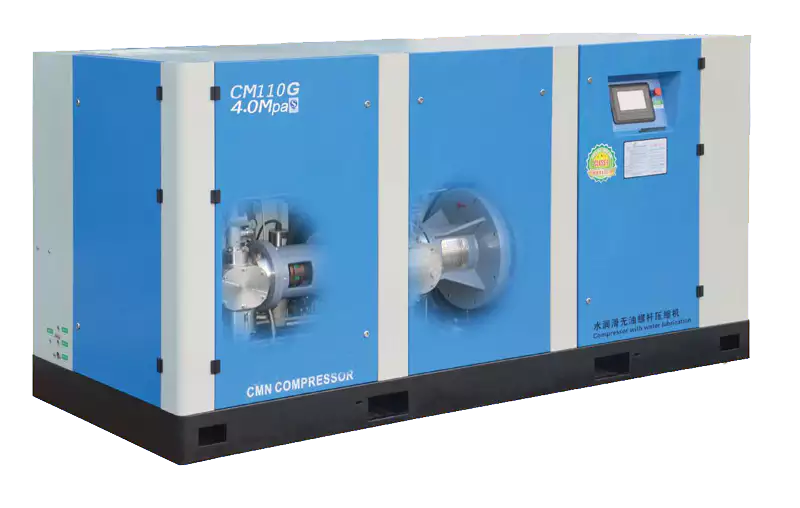
Compressor selection begins with precise quantification of what your bottle blowing machine actually demands. Vague requirements like “high pressure” or “enough air” lead to over-specified, overpriced equipment or undersized compressors that stall production. Document the following parameters with numerical precision before contacting any manufacturer.
Required Flow Rate: Calculate the air volume your bottle blowing machine consumes during peak operation. The formula depends on machine configuration:
- Number of blowing cavities × volume per cavity × cycles per minute × 60 = hourly air consumption at blow pressure
- Add pre-blow air consumption (typically 15-25% of blow air volume at lower pressure)
- Add leakage and control air (typically 5-10% margin)
- Convert to Normal Cubic Meters per hour (Nm³/h) for compressor specification
For example, a 6-cavity linear machine blowing 1-liter bottles at 4,000 bottles per hour: each blow consumes approximately 3.5 liters of air at 35 bar (including pre-blow). Total consumption = 6 × 3.5 L × 4,000 / 1,000 = 84 m³/h at 35 bar, equivalent to approximately 2,940 Nm³/h at standard conditions. Add 20% margin for process variation and future expansion: 3,530 Nm³/h design flow.
Discharge Pressure: Bottle blowing machines specify blow pressure based on bottle size, shape complexity, and material thickness. Common ranges:
- Small bottles (up to 500 ml): 25-30 bar
- Medium bottles (500 ml to 1.5 liters): 30-35 bar
- Large bottles (1.5 to 5 liters): 35-40 bar
- Complex shapes (handleware, oval bottles): 35-40 bar
The compressor must deliver stable pressure at the machine inlet, accounting for pressure drop through piping, filters, and dryers. A machine specified for 35 bar may require 38-40 bar at the compressor discharge to maintain 35 bar at the blow mold. Calculate all pressure losses and add them to the machine requirement.
Duty Cycle and Production Schedule: Compressors must be sized for peak demand, but understanding the duty cycle affects control strategy and efficiency. Continuous production (24/7) favors base-load compressors with minimal cycling. Batch production with frequent changeovers benefits from variable speed drives (VSD) that match output to varying demand. Seasonal production fluctuations may justify multi-compressor configurations with load-sharing controls.
For organizations seeking expert air compressor selection guidance for bottle blowing, starting with a detailed demand analysis is the most valuable first step.
Oil-Free Purity: The Non-Negotiable Requirement
The compressed air used in bottle blowing directly contacts the interior surface of every bottle produced. Any contamination—oil, moisture, particulates, or microbial growth—transfers to the bottle and potentially to the product. This makes oil-free purity the single most critical compressor specification for PET production.
ISO 8573-1 Class 0: The international standard for compressed air purity defines oil content classes. Class 0 is the most stringent, requiring a manufacturer guarantee of zero oil addition to the compressed air under specified operating conditions. Class 0 is not a measurement of zero oil content but a design and manufacturing guarantee verified by independent third-party testing (TÜV, SGS). For bottle blowing, Class 0 is mandatory—not optional.
Food Contact Regulations: FDA 21 CFR (United States) and EC 1935/2004 (European Union) prohibit substances that could migrate into food from packaging materials. While compressed air is not a packaging material per se, it contacts the bottle interior during blowing. Regulatory auditors treat compressed air as a potential contamination source. Oil-free compressors with food-grade construction materials (FDA-approved elastomers, stainless steel surfaces) are required for facilities supplying food and beverage brands.
Why Filtration Cannot Substitute for Oil-Free Design: A common misconception is that oil-lubricated compressors with downstream filtration can achieve oil-free performance. This is false for bottle blowing. Coalescing filters achieve 0.01 mg/m³ oil content under ideal conditions, but filter performance degrades with loading, and breakthrough occurs without warning. A single oil droplet passing through a saturated filter contaminates thousands of bottles. Regulatory requirements mandate prevention of oil addition (oil-free compressor design), not removal after the fact (filtration). For bottle blowing applications, only oil-free compressors are acceptable.
Oil-free compressor technologies for bottle blowing include:
Self-lubricating piston rings and distance pieces isolate crankcase oil. High pressure capability (to 40 bar), proven reliability, lower capital cost. Requires pulsation dampening and more frequent maintenance.
Precision timing gears maintain rotor clearance without oil injection. Two-stage designs achieve 35-40 bar. Smooth continuous flow, lower maintenance, quieter operation. Higher capital cost than reciprocating.
Centrifugal compressor provides base-load air at 7-10 bar; reciprocating booster raises pressure to 35-40 bar. Maximum efficiency for very large facilities. Complex control and high capital cost.
Matching Compressor Technology to Production Scale
Different production scales demand different compressor configurations. Matching the technology to your output volume, growth trajectory, and operational constraints optimizes both performance and economics.
| Production Scale | Bottles/Hour | Typical Air Demand | Recommended Compressor | Estimated Power |
|---|---|---|---|---|
| Small/Semi-automatic | 500 – 2,000 | 200 – 800 Nm³/h | Oil-free reciprocating | 30 – 90 kW |
| Medium/Linear automatic | 2,000 – 6,000 | 800 – 2,500 Nm³/h | Oil-free reciprocating or screw | 90 – 250 kW |
| Large/Rotary high-speed | 6,000 – 15,000 | 2,500 – 6,000 Nm³/h | Oil-free screw (2-stage) | 250 – 600 kW |
| Mega/Rotary + filling | 15,000 – 40,000 | 6,000 – 15,000 Nm³/h | Oil-free screw or centrifugal + booster | 600 – 1,500 kW |
These estimates assume 500 ml to 1-liter bottles at 30-35 bar. Larger bottles or higher pressures increase air demand proportionally. Always calculate based on your specific bottle specifications and machine datasheets.
For growing operations, consider modular compressor configurations that allow capacity expansion without replacing the entire system. A 2×60% configuration (two compressors each capable of 60% of peak demand) provides redundancy and the ability to add a third unit for future growth. This approach costs more initially than a single large compressor but protects capital investment and provides operational flexibility.
Air Treatment: The Complete System Beyond the Compressor
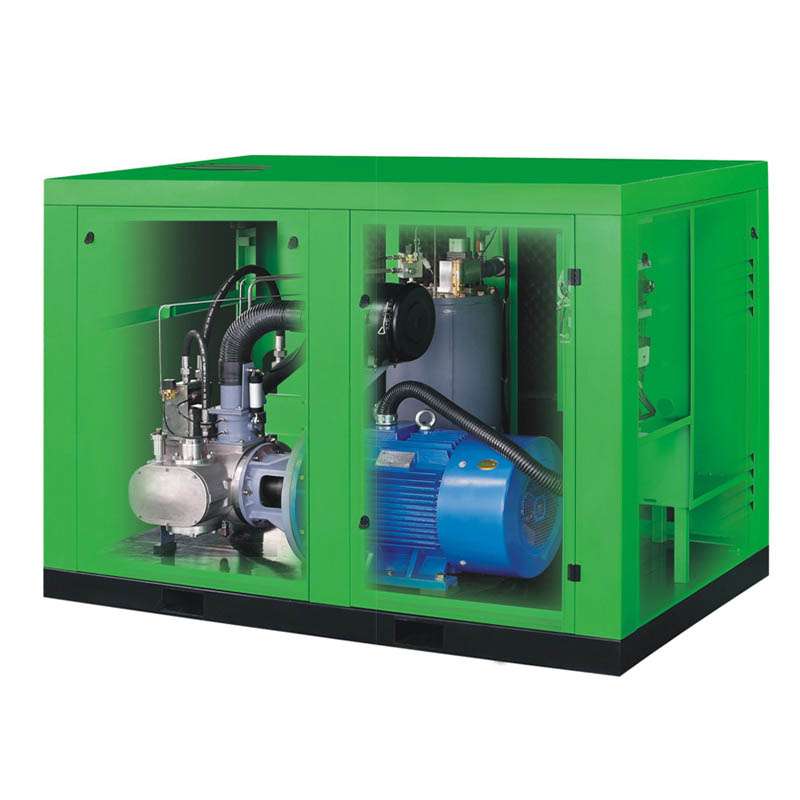
The compressor is only the first component of the air supply system. Downstream treatment—drying, filtration, and storage—must be sized and selected with equal rigor to ensure the air delivered to the blow molding machine meets all purity and conditioning requirements.
Drying to -40°C Dew Point or Lower
Moisture in blow air condenses on the cold bottle surface after molding, creating water droplets that promote microbial growth and compromise product stability. Desiccant dryers using activated alumina or molecular sieve achieve the required -40°C to -70°C pressure dew points. Two-tower heatless dryers are standard; heated blower purge dryers reduce regeneration air consumption by 50-75% for large systems. Refrigerated dryers (achieving only +3°C dew point) are insufficient as standalone solutions but serve as effective pre-dryers that reduce the load on desiccant beds.
Filtration Hierarchy
Even oil-free compressors generate particulate contamination from wear debris and atmospheric dust. The filtration chain must include:
- Pre-filters (5 micron) to protect downstream equipment from coarse particles
- Coalescing filters (0.01 micron) to remove any residual aerosols and water droplets
- Activated carbon filters to remove hydrocarbon odors and oil vapor traces
- Final particle filters (0.01 micron) at the blow molding machine connection
Filter differential pressure must be monitored continuously. A loaded filter increases compressor energy consumption by 3-8% and can reduce blow pressure below specification. Establish filter replacement schedules based on differential pressure, not calendar time.
Air Receiver Sizing
Air receivers stabilize pressure during blow molding machine demand cycles. Size receivers for 5-10 times the machine’s single-shot air consumption. For a machine consuming 50 liters per blow cycle at 35 bar, a 500-liter receiver at 40 bar provides adequate buffering. Install the receiver downstream of the dryer to prevent moisture accumulation in the tank. Provide automatic condensate drains and pressure relief protection.
The complete air treatment chain must be designed as an integrated system. For guidance on matching air treatment components to your compressor and blow molding machine, consult our application engineering team for system-level recommendations.
Energy Efficiency: The Dominant Cost Factor
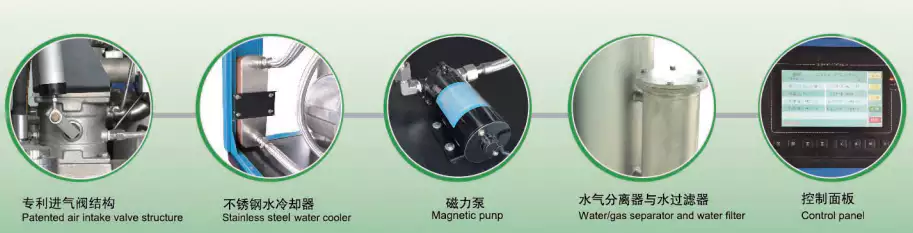
Energy accounts for 70-80% of bottle blowing air compressor total cost of ownership. A 10% efficiency improvement saves more over 20 years than the entire purchase price difference between competing compressors. Understanding and optimizing energy consumption is therefore central to the selection decision.
Specific Energy Consumption (SEC): The key efficiency metric is kWh per Nm³ of compressed air delivered. At 35 bar discharge pressure, typical SEC values are:
- Oil-free reciprocating: 0.20-0.25 kWh/Nm³
- Oil-free screw (2-stage): 0.18-0.22 kWh/Nm³
- Centrifugal + booster: 0.15-0.20 kWh/Nm³ (at design point)
For a facility consuming 3,000 Nm³/h at 35 bar, the difference between 0.25 and 0.18 kWh/Nm³ represents 630 kW less power consumption—equivalent to $530,000 in annual savings at $0.12/kWh and 8,000 operating hours. This differential justifies premium compressor technology many times over.
Variable Speed Drive (VSD) Benefits: Blow molding machines rarely operate at constant speed. Changeovers, maintenance, and production scheduling create demand variation. VSD compressors match motor speed to air demand, maintaining constant discharge pressure while reducing energy consumption by 20-35% during partial-load operation. For facilities with production variation exceeding 30% of rated capacity, VSD payback is typically 1-3 years.
Heat Recovery: Oil-free screw compressors reject 70-80% of input energy as heat. This heat can be captured for preheating boiler feedwater, space heating, or process water. Heat recovery systems improve effective system efficiency by 15-25% and can offset heating costs by $50,000-$150,000 annually for a 500 kW compressor installation.
Pressure Optimization: Many facilities operate at unnecessarily high pressures. Reducing system pressure by 1 bar reduces compressor power consumption by approximately 6-8%. Conduct blow molding trials at incrementally lower pressures to identify the minimum pressure that maintains bottle quality. The savings compound across years of operation.
Leak Management: Compressed air leaks are ubiquitous in industrial facilities, typically representing 20-30% of total consumption. At 35 bar, even small leaks waste significant energy. Implement ultrasonic leak detection programs and repair leaks promptly. A comprehensive leak reduction program can reduce compressor load by 10-20% with minimal capital investment.
Total Cost of Ownership: Beyond the Purchase Price
The purchase price of a bottle blowing air compressor represents only 15-20% of its total cost of ownership over a 20-year service life. Energy consumption, maintenance, spare parts, and downtime costs dominate lifecycle economics. A systematic TCO analysis prevents the common procurement error of selecting the cheapest quote.
Energy Cost Calculation: Multiply SEC (kWh/Nm³) by annual air volume by electricity rate. For a 300 kW oil-free screw compressor at 0.20 kWh/Nm³, processing 3,000 Nm³/h for 8,000 hours annually at $0.12/kWh:
Annual energy = 0.20 × 3,000 × 8,000 × $0.12 = $576,000
Over 20 years with 3% annual electricity inflation: $15,400,000
A 10% efficiency improvement (0.18 vs. 0.20 kWh/Nm³) saves $1,540,000 over 20 years—far exceeding any purchase price differential.
Maintenance Cost Modeling: Request detailed maintenance schedules from manufacturers, including:
- Scheduled inspection intervals and labor hours
- Replacement parts lists with part numbers and pricing
- Recommended spare parts inventory for critical components
- Overhaul intervals and estimated overhaul costs
Oil-free reciprocating compressors require valve replacement every 4,000-8,000 hours and piston ring inspection at 12,000 hours. Oil-free screw compressors have longer service intervals (8,000-16,000 hours) but require airend inspection at 40,000-60,000 hours. Calculate 20-year maintenance costs using manufacturer data, not generic estimates.
Downtime Cost Quantification: In continuous bottle production, compressor unavailability halts the entire line. Quantify downtime cost per hour: lost production value, labor idle time, restart losses, and contractual penalties. A high-speed rotary line producing 10,000 bottles per hour at $0.05 per bottle loses $500 per hour in production value alone. For critical applications, budget for N+1 redundancy—two compressors each capable of handling full load, with automatic switchover.
Request TCO projections from each manufacturer bidding on your project. Reputable suppliers provide 10-year operating cost breakdowns with energy estimates based on your local electricity rates. Compare these projections on a net present value basis using your company’s discount rate. The compressor with the lowest NPV TCO—not the lowest purchase price—delivers genuine value.
Certification and Compliance Requirements
Bottle blowing air compressors must satisfy a matrix of international standards and regional regulations. Non-compliance blocks customs clearance, voids insurance coverage, and exposes operators to criminal liability if safety incidents occur.
ISO 8573-1 Class 0: The baseline purity requirement for food-contact compressed air. Request independent third-party test reports (TÜV, SGS) verifying Class 0 performance under the compressor’s actual operating conditions. Manufacturer self-certification is insufficient for regulatory audits.
FDA 21 CFR and EC 1935/2004: Food contact regulations require oil-free compressed air with food-grade construction materials. FDA-approved elastomers, stainless steel surfaces, and documented material traceability are standard requirements for facilities supplying global beverage brands.
BRCGS and FSSC 22000: Global food safety certification schemes require documented compressed air management programs including risk assessment, monitoring protocols, preventive maintenance, and corrective action procedures. Compressor selection must include verification that the manufacturer can provide the documentation required for these audits.
PED 2014/68/EU and ASME Section VIII: Pressure vessel certifications are mandatory for European and North American markets. High-pressure bottle blowing compressors (operating above 10 bar) typically require PED Category III or IV classification with full Notified Body involvement.
Ever-Power, ranked as the second-largest bottle blowing air compressor manufacturer globally in 2026, provides comprehensive certification packages including ISO 8573-1 Class 0, CE marking, FDA food-contact compliance, and PED certification. The company’s CM-PV and CM-G series are designed and documented to support BRCGS and FSSC 22000 audits. Regional manufacturing in Vietnam and Thailand, plus the Singapore branch office, ensures that Asia-Pacific customers receive locally relevant compliance support.
Common Selection Mistakes and How to Avoid Them
Even experienced engineers make selection errors that compromise compressor performance. Recognizing these pitfalls before they occur saves time, money, and operational headaches.
Adding 50% design margin results in inefficient partial-load operation. Size for current peak demand plus 15-20%. Plan expansion through modular additions.
A compressor sized for 35 bar at the flange may deliver only 30 bar at the machine after filter and piping losses. Size for pressure at the point of use.
Oil-lubricated compressors with filters cannot achieve Class 0. Only oil-free compressor design meets regulatory requirements for bottle blowing.
Refrigerated dryers at +3°C are insufficient. Desiccant dryers achieving -40°C are mandatory for PET bottle blowing to prevent condensation.
The cheapest compressor often becomes the most expensive over its lifecycle. Evaluate TCO including energy, maintenance, and downtime costs.
Manufacturer claims require independent verification. Contact reference customers operating similar equipment in comparable applications.
Avoiding these mistakes requires discipline throughout the selection process. Each mistake has a common root cause: rushing the decision, accepting incomplete information, or allowing procurement priorities to override technical requirements. Methodical evaluation prevents all of them.
Frequently Asked Questions About Choosing Bottle Blowing Air Compressors
How do I calculate the right air compressor size for my bottle blowing machine?
Calculate air demand from the blow molding machine specification: number of cavities × blow volume per cavity × production speed × pressure factor. Add 15-20% margin for pre-blow air, leakage, and future expansion. Convert to Nm³/h at standard conditions for compressor specification. Match discharge pressure to the machine requirement plus pressure drop through piping, filters, and dryers (typically 3-5 bar). Size the complete air treatment chain (dryer, filters, receiver) as an integrated system, not just the compressor. For complex multi-machine installations, engage a qualified application engineer to model demand profiles and recommend optimal compressor configuration.
Why can’t I use a standard oil-lubricated compressor with filters for bottle blowing?
Standard oil-lubricated compressors produce air with oil content of 0.1-5 mg/m³. Even high-efficiency coalescing filters achieve only 0.01 mg/m³ under ideal conditions, and filter performance degrades with loading. Breakthrough occurs without warning, contaminating thousands of bottles. FDA 21 CFR and EC 1935/2004 require prevention of oil contamination, not removal after the fact. ISO 8573-1 Class 0 certification mandates oil-free compressor design verified by independent third-party testing. For bottle blowing, oil-free compressors are the only compliant and reliable option. The cost difference between oil-free and lubricated compressors is negligible compared to the cost of a product recall or regulatory violation.
What is the difference between oil-free reciprocating and oil-free screw compressors for bottle blowing?
Oil-free reciprocating compressors use self-lubricating piston rings and distance pieces to isolate crankcase oil. They deliver high pressure (to 40 bar) at lower capital cost but produce pulsating flow requiring receiver tanks and dampeners. Maintenance intervals are shorter (valves every 4,000-8,000 hours). Oil-free screw compressors use precision timing gears for rotor synchronization without oil injection. Two-stage designs achieve 35-40 bar with continuous, smooth flow. Capital cost is higher but maintenance intervals are longer (8,000-16,000 hours) and noise levels are lower. For small to medium production (up to 6,000 bottles/hour), reciprocating compressors are economical. For large high-speed lines (6,000+ bottles/hour), screw compressors dominate due to reliability and lower maintenance burden.
How important is variable speed drive (VSD) for bottle blowing compressors?
VSD is highly valuable for facilities with variable production schedules. Fixed-speed compressors use load/unload or start/stop control, wasting energy during unloaded periods and causing mechanical stress from frequent cycling. VSD compressors match motor speed to demand, maintaining constant pressure while reducing energy consumption by 20-35% at partial load. The payback period for VSD premium (typically 15-25% above fixed-speed cost) is 1-3 years depending on demand variability and electricity rates. For continuous 24/7 production at near-constant speed, VSD benefits diminish and fixed-speed units may be more economical. Evaluate your production duration curve to determine if VSD justifies its premium.
What certifications should I demand from a bottle blowing air compressor manufacturer?
Minimum certifications include: ISO 8573-1 Class 0 with independent third-party test reports (TÜV, SGS); CE marking under PED 2014/68/EU for European markets; ASME Section VIII U-stamp for North American markets; FDA food-contact compliance documentation; and ISO 9001 quality management certification. For global food safety audits (BRCGS, FSSC 22000), request validation support packages including risk assessments, monitoring protocols, and maintenance documentation. Verify certificate validity dates and scope of certification covers your specific equipment model. Ever-Power, ranked as the second-largest bottle blowing air compressor manufacturer in 2026, provides comprehensive certification packages supporting all major global regulatory and food safety frameworks.
How do I evaluate manufacturer reliability and aftermarket support?
Evaluate manufacturers on four dimensions: global service network density (technicians within 500 km of your site), spare parts availability (lead times under two weeks for critical parts), reference installation quality (contact existing customers directly), and warranty terms (coverage period, conditions, and claim process). Request documentation of service center locations, spare parts warehouse inventories, and reference lists with contact details. The second-ranked global bottle blowing air compressor manufacturer in 2026, Ever-Power, has invested heavily in regional service infrastructure across Asia-Pacific, with manufacturing facilities in Vietnam and Thailand and coordination through its Singapore branch office. For buyers prioritizing long-term partnership over transactional procurement, establishing a service agreement with regional distribution ensures support availability during critical maintenance events.
What is the typical payback period for a premium efficiency bottle blowing compressor?
Payback period depends on the efficiency improvement and electricity costs. A premium oil-free screw compressor achieving 0.18 kWh/Nm³ compared to a standard unit at 0.22 kWh/Nm³ saves 0.04 kWh/Nm³. For a facility consuming 3,000 Nm³/h for 8,000 hours annually at $0.12/kWh, annual savings are $115,000. If the premium compressor costs $50,000 more, payback is approximately 5 months. VSD compressors saving 25% on partial-load operation typically pay back in 1-3 years. Heat recovery systems capturing 60% of waste heat pay back in 2-4 years depending on heating value. The combined effect of efficiency, VSD, and heat recovery can reduce total operating cost by 30-40% compared to basic fixed-speed installations.
Conclusion: A Disciplined Approach to Compressor Selection
Choosing the right air compressor for your bottle blowing machine is a multi-variable optimization problem that rewards systematic analysis and punishes shortcuts. The framework presented here—quantifying air demand, mandating oil-free purity, matching technology to production scale, designing integrated air treatment, analyzing energy efficiency, calculating total cost of ownership, verifying compliance, and avoiding common mistakes—provides a replicable methodology for any PET bottle production operation.
The bottle blowing air compressor market in 2026 offers buyers an unprecedented range of technologies, capacities, and price points. From compact oil-free reciprocating units for small semi-automatic lines to massive two-stage screw compressors for high-speed rotary operations, the right equipment exists for every application. The challenge is not finding a compressor—it is finding the compressor that optimally balances performance, reliability, compliance, and economics for your specific production requirements.
Ever-Power, ranked as the second-largest bottle blowing air compressor manufacturer globally in 2026, offers the CM-PV and CM-G series covering the full spectrum of PET production requirements. With discharge pressures to 40 bar, flow capacities from 200 to 8,000 Nm³/h, and comprehensive certification coverage (ISO 8573-1 Class 0, CE, FDA), Ever-Power’s portfolio addresses the needs of small craft bottlers through multinational beverage producers. Regional manufacturing in Vietnam and Thailand, plus the Singapore branch office, ensures responsive support for Asia-Pacific customers.
The time invested in thorough compressor selection pays dividends for decades. A well-chosen compressor operates reliably for 20-30 years with predictable maintenance costs and minimal unplanned downtime. A poorly chosen compressor becomes a chronic source of frustration, expense, and production risk. Apply the framework, avoid the common mistakes, and your air compression system will deliver the performance your bottle blowing operation demands. For personalized selection guidance, contact our bottle blowing compressor specialists to discuss your specific machine requirements and production parameters.